Enhance enable is available to everyone who works for NHS England from 2024 onwards. Some of the practical information on this page is aimed at foundation doctors, but we would encourage anyone who is interested to take part. This page will tell you a bit more about what the programme is and how you can get involved. If you are wondering how to get signed off, this information is covered here. You can also access the page for each module here. If you think there are any other resources that might be helpful please contact us. We are always looking to improve our website.
Contents
Isn’t it just something extra to do?
Can I get anything extra for completing enhance?
Do I have to complete all the modules?
What resources are available to help me?
How is enhance relevant to Kent, Surrey and Sussex?
What is enhance?
This short video explains everything you need to know about enhance:
This short, interactive document also explains the programme in more detail. The locally produced factsheet below also explains the enhance programme and has links to lots of national documents:
Isn’t it just something extra to do?
No! Enhance has been designed around the foundation curriculum, so any work you do on it will also count towards your ARCP. Enhance just helps you look at the foundation HLOs in a more holistic (and more interesting) way. From August 2026, the principals of enhance will be specifically included in the foundation curriculum, meaning you will be doing a lot of this work anyway.
Can I get anything extra for completing enhance?
For many programmes, the leadership module can be used to gain points. Enhance is also an excellent opportunity to broaden your horizons and understand how to be an effective doctor in the modern NHS. This will give you plenty to talk about at interviews that will set you apart from other candidates.
How do I complete enhance?
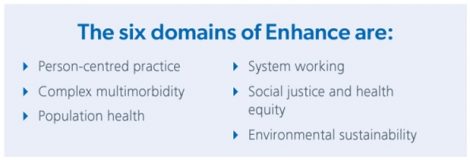
Enhance enable is divided into six domains. These cover different elements of generalism that are important to modern medical practice.
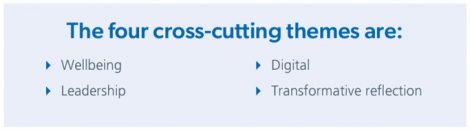
There are also four ‘cross-cutting themes’ on the enhance programme, which each module touches on in some way.
The programme has six modules in total: introduction, person centred practice, complex multimorbidity, population health, 3-in-1 (systems working, social justice and health equity, environmental sustainability) and contextual leadership. Each has a workbook that outlines the learning objectives for the module, and explains the evidence needed for completion.
Each enhance module should take a minimum of six hours to complete. The programme is deliberately broad, which allows you to pick your own path through the work. You can use a variety of learning methods to complete each module, including;
- Relevant core foundation teaching
- Non-core teaching, such as eLearning or online lectures
- Reflection on clinical events
- Shadowing other health- or social care professionals
- Engaging with patient lived experience, through speaking to NHS service users or by using content created by patients
- Using the arts to understand relevant issues. You can read novels, memoirs or poetry, listen to music, or view artworks that touch upon the themes covered in the module. Some foundation have even made their own work
Regardless of the work you choose to do for each module, you should complete at least one of the following for each module:
- One case-based discussion with an explicit focus on an element of the module
- Reflection on a clinical experience
- Engage with lived experience of a patient
- Shadow or work alongside a member of the MDT
- Take part in a QI project which is relevant to the module
Do I have to complete all the modules?
No! The national enhance team recommend completing the first three modules in FY1 and the second three modules in FY2. However, the programme is flexible, and you can work through the modules in any order they like. There is no requirement to finish all six modules, and you may pick and choose the ones that feel most useful. You can do what works for you.
What resources are available to help me?
This website has lots of resources, including videos, podcasts, eLearning and videos. You can find them on the site menu, just select the module you are interested in.
The national website also has a lot of helpful information. You can find the main site here. You can also access the learning hub here (login with an NHS email is required.)
Why is this relevant to me?
In foundation, the most important bit of medicine can seem like the clinical knowledge. Whilst this is undoubtably important, knowing how to communicate, navigate complexity and practice in a patient centred care are also essential. Without these skills, practicing in the modern NHS is extremely difficult and often unsatisfying.
How is enhance relevant to Kent, Surrey and Sussex?
KSS as a region is highly varied and each area faces many healthcare challenges. As healthcare professionals we are often expected to move around the region, meaning we may experience a wider range of issues than those working in other areas.
In KSS we have over 300km of coastline. Coastal areas experience disproportionate levels of deprivation and inequality nationally. This is true of us in KSS, where our costal regions have more ageing and deprived communities than the national average. This is most striking in Hastings, where almost half of the town’s residents live in areas ranked in the 20% most deprived areas of England. The twenty most deprived areas of Kent are all by the coast and 18% of children in Thanet are currently living in poverty.
Despite these figures, our coastal areas have fewer healthcare professionals per patient. Access to healthcare can often be challenging more generally, with many individuals having to travel to multiple centres to access specialist services.
One of the other major healthcare challenges in our region is our ageing population. Our population is older than the national average. In Surrey, 1 in 5 residents are now over 65. In the next ten years, Sussex expects its population of over 85’s to rise by 25%. Whilst many individuals can live healthily into later life, older people are disproportionately affected by multimorbidity and use healthcare services more than their younger counterparts.
Some areas have their own specific issues. Brighton and Hove has the highest rate of HIV per head of population in the South East of England. It also has a much higher prevalence of drug misuse than the national average, with the 9th highest rate of death from overdose in the UK. Surrey has the fourth highest population of Gypsy, Roma and traveller residents of any local authority. Delivering good quality healthcare for these populations can be extremely challenging. Understanding these differences, and how to navigate them, is essential to practice medicine effectively in our region. We hope that by helping you to understand these issues, we can create a healthcare system that is truly responsive to the needs of the people we serve. We hope that you choose to explore some of these issues, or any others that you find are relevant, during your enhance work.